<?xml version="1.0" encoding="utf-8"?><feed xmlns="http://www.w3.org/2005/Atom" ><generator uri="https://jekyllrb.com/" version="3.10.0">Jekyll</generator><link href="/feed.xml" rel="self" type="application/atom+xml" /><link href="/" rel="alternate" type="text/html" /><updated>2026-02-06T08:53:24+00:00</updated><id>/feed.xml</id><title type="html">Dawson Ren</title><subtitle>Exploring the world and raising my coefficient of curiosity.</subtitle><entry><title type="html">Priming Your Brain For Classes</title><link href="/advice/2024/01/03/priming-your-brain.html" rel="alternate" type="text/html" title="Priming Your Brain For Classes" /><published>2024-01-03T18:00:00+00:00</published><updated>2024-01-03T18:00:00+00:00</updated><id>/advice/2024/01/03/priming-your-brain</id><content type="html" xml:base="/advice/2024/01/03/priming-your-brain.html"><![CDATA[<p>It’s the first day of a new quarter (and new year!), and classes are starting again. In order to prepare myself after a long break, I usually try to “prime my brain” by getting an overall idea of what each class is about and what applicable knowledge I bring into the class. “Priming” is a word from psychology, which is the idea that <a href="https://en.wikipedia.org/wiki/Priming_(psychology)">“exposure to one stimulus may influence a response to subsequent stimulus”</a>. By researching class topics before you hear them in lecture, I believe you can greatly improve how much you understand during the quarter, which cuts down on study time. Since I’ve done this for the past 4 years, I’m codifying what this process looks like for future me, as it’ll be helpful in graduate school.</p>

<p>The main purpose of “priming my brain” is to make connections between concepts I already know and concepts I’ll encounter in the future. That way, I’m not caught off-guard when things get complicated in the later part of the quarter.</p>

<p>The main deliverable is a “roadmap” for what I’ll be learning. My Real Analysis class this past fall did a great job with this - the professor highlighted which key theorems we’d be proving and how <a href="https://sites.math.northwestern.edu/~scanez/courses/320/notes/lecture-notes-320-1.pdf">they’re all related</a> on the first day of class. The roadmap highlights 1. what topics I should already know, 2. what I will learn, and 3. what intuitions I need to build along the way. Keep in mind that this is mainly for STEM fields where classes and concepts tend to follow a strict progression, so I’m not sure how useful this advice is otherwise.</p>

<p>In case my future self is feeling lazy, a quick reminder of the benefits of this approach:</p>
<ol>
  <li>Helps you catch holes in your knowledge/things you should already know before you begin the class</li>
  <li>As you’re creating the roadmap, you may come across proof techniques/lemmas that will be on the homework later.</li>
  <li>Since you know what’s coming up and how it fits into the bigger picture, you can “think ahead” during lecture rather than scrambling to make everything fit together.</li>
</ol>

<p>And a warning: the <a href="https://www.lunarmobiscuit.com/the-forest-of-all-knowledge/">Forest of All Knowledge</a> is an never-ending, ever-expanding fractal. Try to stick to a breadth-first search approach rather than a depth-first search. Your goal is to create a sketch that you can fill in as you take the class, not one really detailed portion. Basically, if you’re anything like me, limit the number of tangents you go on!</p>

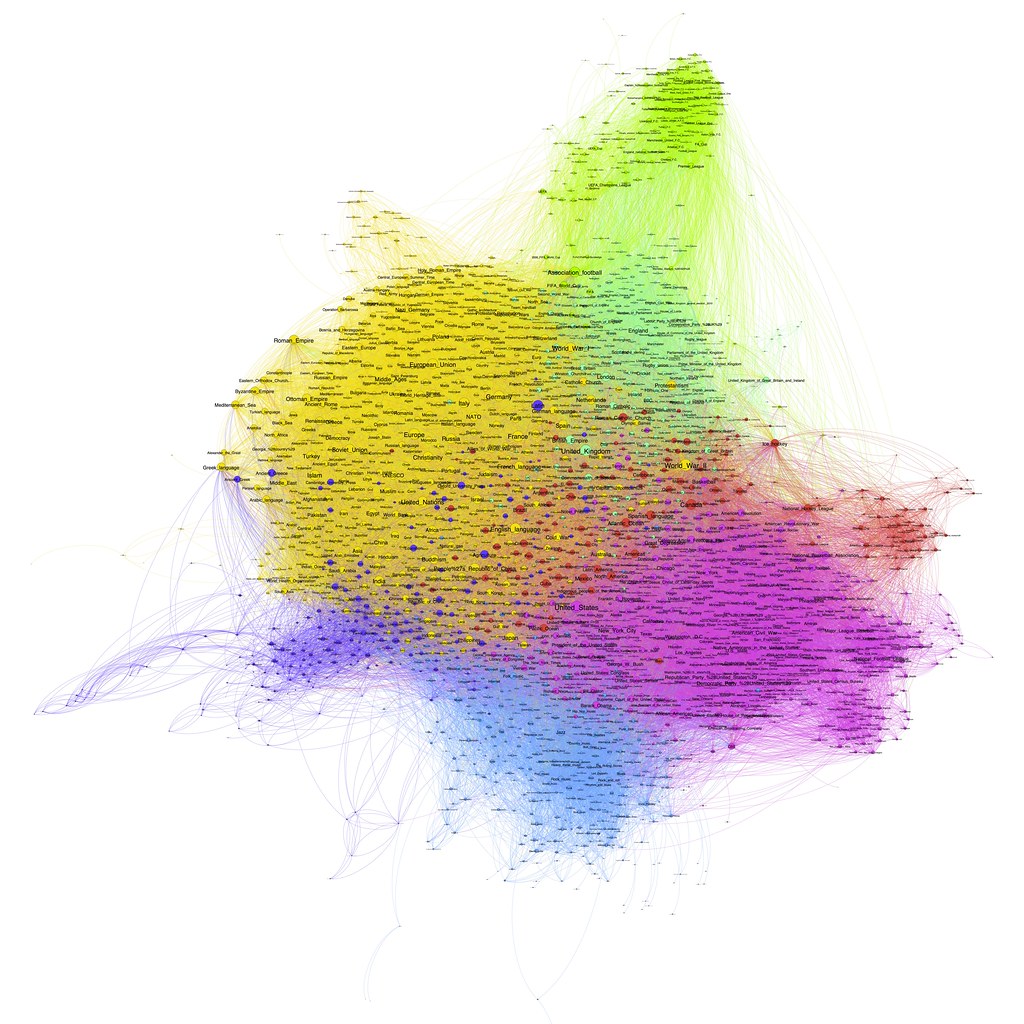
<p><img src="/assets/wikipedia_fractal.jpg" alt="A fractal image of hyperlinks between Wikipedia articles." /></p>

<p>The Process:</p>
<ol>
  <li>Gather resources. Some good places to look are your Canvas/class webpage and the textbook. If they’re lacking, you can usually find syllabi for similar classes at other universities with a quick online search.</li>
  <li>Create the document. Make a list of the main topics you’ll be covering, in order. Don’t worry if they don’t make a whole lot of sense!</li>
  <li>Review the basics. Every textbook usually contains a first chapter/appendix that highlights prerequisites. Make sure you feel comfortable with those first. This can look like a brief skim at your previous lecture notes, or doing a few relevant practice problems.</li>
  <li>Fill in the gaps. Define confusing terms in your class from the list of topics. Don’t feel like you have to use the most technical definition, just try to intuitively understand how it relates to the larger topic. You may need to go a few layers deep on definitions to get to something you understand. I usually just use a search engine, although I increasingly use ChatGPT (with manual double-checking, or using GPT-4 with citations). YouTube videos and blog posts are another way to make this information digestible.</li>
  <li>Make connections. Spot where concepts you learned previously come into play. For example, in my philosophy class, I’m learning about formal logical systems. Although this is my first philosophy class, I can connect my knowledge of mathematics (how to use quantifiers) and programming languages (syntax and semantics) to the topic. It’s helpful to explicitly write this out so the connection runs deeper than “oh, that seems familiar”.</li>
</ol>

<p>Once you’ve completed this process, the roadmap doesn’t have to be something you look back on. The law of diminishing returns applies here too, you’ll probably learn extraneous and unnecessary information if you research for too long (an hour for each class usually works for me, longer if I need to review concepts from previous classes). This process ultimately prepares you to become a lifelong learner, as you discover self-learning resources and digest large concepts without having all the details.</p>

<p>Happy learning, and good luck on your classes!</p>]]></content><author><name></name></author><category term="advice" /><summary type="html"><![CDATA[It’s the first day of a new quarter (and new year!), and classes are starting again. In order to prepare myself after a long break, I usually try to “prime my brain” by getting an overall idea of what each class is about and what applicable knowledge I bring into the class. “Priming” is a word from psychology, which is the idea that “exposure to one stimulus may influence a response to subsequent stimulus”. By researching class topics before you hear them in lecture, I believe you can greatly improve how much you understand during the quarter, which cuts down on study time. Since I’ve done this for the past 4 years, I’m codifying what this process looks like for future me, as it’ll be helpful in graduate school.]]></summary></entry><entry><title type="html">The Manager and the Rubber Duck</title><link href="/reflections/2023/11/02/manager-and-rubber-duck.html" rel="alternate" type="text/html" title="The Manager and the Rubber Duck" /><published>2023-11-02T16:53:01+00:00</published><updated>2023-11-02T16:53:01+00:00</updated><id>/reflections/2023/11/02/manager-and-rubber-duck</id><content type="html" xml:base="/reflections/2023/11/02/manager-and-rubber-duck.html"><![CDATA[<p>During my research meeting this past Tuesday, my advisor kept on repeating: “Pretend I’m a manager. I’m interested in the practical applications of your work, but not the technical details. What did you learn?” This was to help me from going on runaway tangents about the assumptions I made and the different experiments I ran with different distributions, and don’t forget that the coefficient of variance doesn’t matter in this case, and on and on.</p>

<p>I’ve learned a lot about importance of explaining technical concepts simply from my experiences as a tutor and teaching assistant - break things down into managable pieces until you start on the same level of understanding. What I realized I haven’t learned is how to explain concepts both simply <em>and convincingly</em>. Forcing yourself to explain something to a manager shocked me into the correct frame of reference.</p>

<p>A manager doesn’t understand jargon and wants things boiled down to simple rules. If I encounter situation X, I should do Y, unless I observe Z, in which case I should do A. This constraint forces me to make abstractions. If I don’t have enough information to construct one, then I should investigate until I do. If reality is complicated and multi-branched, then what’s the most common case and its associated action, and that’s a procedure we can follow the rest of the time?</p>

<p>Setting up the “manager” as a tool to help me better do research reminds me of the software developer’s <a href="https://blog.codinghorror.com/rubber-duck-problem-solving/">“rubber duck”</a>. When a developer encounters a problem or a bug, they should totally commit to explanining it in detail to an inanimate object. Usually, the problem reveals itself in the complexity, as a kind of depth-first-search approach to thinking takes over and every minor detail is interrogated for being the potential source of the problem. It’s this kind of thinking that I’m most used to, and also the one that’s the least useful to managers!</p>

<p>Whereas the rubber duck is a microscope, the manager is a macro lens, forcing you to abstract away from the details. The next time I talk to my advisor, I’ll make sure to have a long chat with the manager beforehand.</p>]]></content><author><name></name></author><category term="reflections" /><summary type="html"><![CDATA[During my research meeting this past Tuesday, my advisor kept on repeating: “Pretend I’m a manager. I’m interested in the practical applications of your work, but not the technical details. What did you learn?” This was to help me from going on runaway tangents about the assumptions I made and the different experiments I ran with different distributions, and don’t forget that the coefficient of variance doesn’t matter in this case, and on and on.]]></summary></entry><entry><title type="html">How to Explain Industrial Engineering to Your Family and Friends</title><link href="/peermentor/2023/10/10/what-is-ie.html" rel="alternate" type="text/html" title="How to Explain Industrial Engineering to Your Family and Friends" /><published>2023-10-10T18:36:01+00:00</published><updated>2023-10-10T18:36:01+00:00</updated><id>/peermentor/2023/10/10/what-is-ie</id><content type="html" xml:base="/peermentor/2023/10/10/what-is-ie.html"><![CDATA[<p>You’ve heard it before, from your friends and family: so what really is Industrial Engineering? Before a cogent response comes to mind, you can see the interest draining out of their eyes, so you briefly mumble something about probability and statistics. It looks like “Industrial Engineering” will remain an enigma, for now.</p>

<p>Industrial Engineering, like most other fields of engineering, was created to meet the rising demands of the Industrial Revolution. As mechnical engineers created cars and material scientists invented new formullations of steel, industrial engineers rose to meet the challenge of organizing and integrating people, information, materials, and equipment as businesses operated in increasingly complex environments. It is within this larger, organizational and systemic context that IEs operate.</p>

<p>Although IE is most commonly associated with manufacturing and distribution (think six sigma, lean manufacturing, and supply chain, take IE 381/382 if you’re interested in these), it turns out that the process of examining complex systems using mathematical tools is incredibly useful in other disciplines. IEs can work in healthcare, finance, and often work as managers. It’s no wonder that many CEOs also happened to be IEs in college, such as Tim Cook (CEO of Apple).</p>

<p>INFORMS, or the Institute for Operations Research and Management Science, is the largest professional organization for IEs. It summarizes its mission as advancing the science and technology and decision making to “save lives, save money, and solve problems”. This is what I think IE is about - in a complex world, how do we know what decisions are available to us, predict their outcomes, and choose the optimal one?</p>

<p>Ultimately, your definition of IE will depend on your experiences, whether it’s classes, extracurriculars, mentors, or jobs. And that’s the best part about this major - ultimately, it’s up to you how you define it and what you do with it. The possibilities are only constrained by your imagination. Maybe that’s why they call us “imaginary engineers”!</p>]]></content><author><name></name></author><category term="peermentor" /><summary type="html"><![CDATA[You’ve heard it before, from your friends and family: so what really is Industrial Engineering? Before a cogent response comes to mind, you can see the interest draining out of their eyes, so you briefly mumble something about probability and statistics. It looks like “Industrial Engineering” will remain an enigma, for now.]]></summary></entry><entry><title type="html">A Letter to Thomas Bayes</title><link href="/letters/2023/02/25/letter-to-bayes.html" rel="alternate" type="text/html" title="A Letter to Thomas Bayes" /><published>2023-02-25T23:15:32+00:00</published><updated>2023-02-25T23:15:32+00:00</updated><id>/letters/2023/02/25/letter-to-bayes</id><content type="html" xml:base="/letters/2023/02/25/letter-to-bayes.html"><![CDATA[<p style="text-align: center;">Mr. Ren’s Letter to Rev. Bayes<br />containing some reflections on the<br />his contributions to the field of probability</p>

<p>Sr.</p>

<p>It is a pleasure to make your acquaintance, dear sir, and I hope that you will suffer no guilt if you must ignore this letter, since I am sure that you are a busy and industrious man.</p>

<p>I am a student of yours in the year 2023. How you have happened upon a student you have never taught, I will now tell.</p>

<p>After your demise, your dear friend Richard Price published the <a href="https://royalsocietypublishing.org/doi/10.1098/rstl.1763.0053">“Essay towards solving a Problem in the Doctrine of Chances”</a> in the Royal Society. This work is the foundation for a large part of my learning from my university, indeed, it has left an indelible mark on the world.</p>

<p>In your own words, “If there be two subsequent events, the probability of the second bN and the probability of both together P / N, and it being first discovered that the second event has also happened, from hence I guess that the first event has also happened, the probability I am right is P / b”. To readers today, we might say that the probability of a second event happening given the first is equal to the probability of both events divided by the probability of the first, or that</p>

<pre><code class="language-math">P(B | A) = P(B ∩ A) / P(A)
</code></pre>

<p>Although this comment might have seemed innocuous at first, we now have an entire branch of statistics which bears your name: Bayesian statistics. From this I have gleaned that we are rarely remembered for the contributions that we hold most dear, but rather, ideas take on a mind of their own once exposed to the world.</p>

<p>If only you could see the applications of your work! We have made tremendous advances in probability and statistics, deriving models of inference that drive the daily activities of our society.</p>

<p>Imagine a world where sending a letter takes not weeks, but seconds through a network of wires that connect across oceans and continents, and words are not spelled on parchment, but through zeros and ones. You can communicate with anyone near-instantaneously, as long as you have their address. Unfortunately, letters from your family are drowned in a sea of correspondence from your rival academics. They constantly bombard you with letters written under psuedonyms (those cowards!) <a href="https://www.maths.tcd.ie/pub/HistMath/People/Berkeley/Analyst/Analyst.pdf">attacking Newton’s theory of calculus</a> which you esteem so highly, causing you to miss a letter for your niece’s birthday celebration.</p>

<p>After buying a gift for your niece, you resolve to create a method to filter the letters you receive, classifying them either as ignorant tirades from inferior academics, or earnest requests for a new wooden rocking horse. Each letter contains a frequency of words, and given that a letter mentions “mathematics”, we might say with more confidence that the letter is written by those scoundrels. However, this might also eliminate the letters from your friend <a href="https://royalsocietypublishing.org/doi/pdf/10.1098/rstl.1763.0044">John Canton</a> from the Royal Society! And so, you might also look for the words “calculus”, “Newton”, and “<a href="https://en.wikipedia.org/wiki/Fluxion">fluxion</a>”. The presence of these words in the letter provide valuation information in determining whether or not the letter is worthy of being read.</p>

<p>Let the second event be that the word “calculus” is in the letter, and the first event that a spiteful hand wrote the letter, what we might call “spam”. We can obtain a first approximation for the probability the letter is “spam” by taking the number of letters that both contain the word “calculus” and are “spam” divided by the total number letters that contain the word “calculus” in general.</p>

<pre><code class="language-math">P(spam | calculus) = P(spam ∩ calculus) / P(calculus)
</code></pre>

<p>As we add more and more words, we add more and more conditions. If we make the simplifying assumption that the probability of any word being present is independent of any other word, we obtain the <a href="https://en.wikipedia.org/wiki/Naive_Bayes_classifier">Naive Bayes Classifier</a> under the Bernoulli distribution.</p>

<p>There is much else that I have to write to you about, but I have fluxions of my own to deal with in my real analysis homework. Until later, Reverend Bayes!</p>

<p>Yours,
Mr. Ren</p>]]></content><author><name></name></author><category term="letters" /><summary type="html"><![CDATA[Mr. Ren’s Letter to Rev. Bayescontaining some reflections on thehis contributions to the field of probability]]></summary></entry></feed>